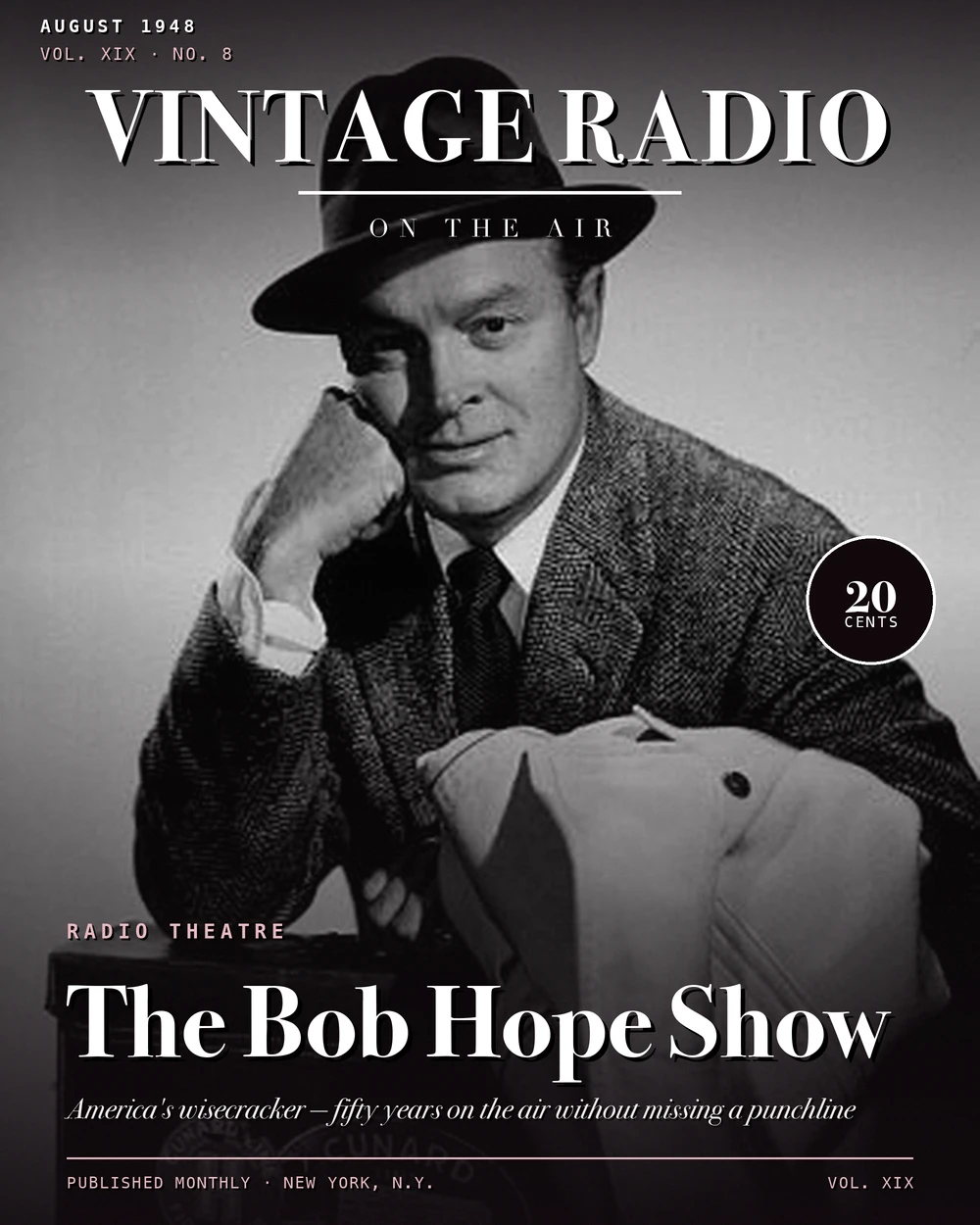
The Bob Hope Show
At its peak in 1942, The Pepsodent Show Starring Bob Hope was pulling Hooper ratings of 40 points and seldom dropping out of the 30s. That put it squarely among the biggest programs on American radio, sitting right behind Fibber McGee and Molly on NBC's Tuesday night lineup — a one-two punch that made the network nearly unbeatable that evening of the week. But the raw numbers only hint at what the show actually was: a precision comedy machine, built around one of the fastest mouths in broadcasting, staffed by a rotating army of writers, and eventually dragged out of the studio entirely to perform for servicemen in some of the most remote and dangerous corners of the world.
How He Got There
Bob Hope's road to radio stardom was longer and more crooked than his eventual success suggests. He was born Leslie Townes Hope in England on May 29, 1903. His mother had been a concert performer on the Welsh stage and taught him to sing. His father was a stonemason who brought the family — eight children in all — to the United States in 1907. The name "Bob" was his own choice, adopted to avoid being ribbed by other kids.
Before radio, Hope tried almost everything show business had to offer. He boxed under the name "Packy East" and made it to the Golden Gloves finals. He teamed with a young dancer named George Byrne for a vaudeville act called Two Diamonds in the Rough, playing small Midwest towns. The act involved blackface, which was common in that circuit at the time, and the pair eventually made it to New York and Broadway. In 1928 they decided to try Chicago, and it was at a stopover in Newcastle, Indiana, that Hope first tried a solo monologue after growing disenchanted with the blackface routine. It got good laughs. He broke up the partnership.
His stage work grew steadily more prominent: a role in Ballyhoo of 1932, then Jerome Kern's Roberta in 1933, playing a piano-playing fast-talker named Huckleberry Haines, then standout parts in both Ziegfeld's Follies and Cole Porter's Red, Hot, and Blue in 1936 — the latter alongside Ethel Merman and Jimmy Durante. Radio came into the picture when an engagement at New York's Capitol Theater in 1932 led to a spot on Major Edward Bowes's Capitol Family Hour, where Hope provided comic relief on an otherwise serious concert music program. He discovered quickly that submitting scripts in advance was a mistake — on broadcast day, Bowes had taken the best lines for himself.
His earliest attempts at a dedicated radio series were modest. The Intimate Revue on the Blue Network ran from January 4 to April 5, 1935, sponsored by Emerson Drug for Bromo Seltzer. The cast included singers James Melton and Jane Froman and a Southern eccentric named Patricia "Honey Chile" Wilder, whom Hope had spotted in an agent's office and thought was a natural for radio. Hope later wrote in his autobiography that the sponsors took so much of their own product that they "finally shucked the whole deal" — and the ratings were mediocre anyway. A series for Atlantic Oil on CBS followed in 1935 and 1936, then The Rippling Rhythm Revue on the Blue Network in 1937, sponsored by Woodbury Soap, which took its name from a musical gimmick by bandleader Shep Fields, who blew bubbles while the orchestra played.
It was Paramount's offer of a part in The Big Broadcast of 1938 that changed the trajectory. Hope moved to Hollywood but kept the revue going via transcontinental wire, delivering his monologues from the West Coast. In that film, he sang a duet with Shirley Ross — "Thanks for the Memory" — and the combination of the film and his concurrent appearance on Your Hollywood Parade on NBC set the stage for the show that would define him.
The Pepsodent Years
The Pepsodent Show Starring Bob Hope launched on NBC on September 27, 1938, in a 30-minute Tuesday slot at 10 p.m. Hope signed a ten-year contract with Lever Brothers, the manufacturer of Pepsodent — not a single-season tryout — and the show ran until June 8, 1948, nearly a full decade of weekly comedy on the same network, the same sponsor, and the same night. The first broadcast featured Constance Bennett as guest star; the second, a week later, brought Olivia de Havilland and Patsy Kelly. By any measure, this is the core of Hope's radio career.
The opening cast set a template that would be refined but rarely abandoned. Announcer Bill Goodwin, bandleader Skinnay Ennis, and Jerry Colonna were there from the start. Colonna had been a serious trombonist before the show — he had played with Benny Goodman, Artie Shaw, and both Dorseys, and as a member of the CBS house orchestra in the early 1930s he broke up the other players in rehearsals so consistently that he started getting hired for comic warm-ups on live broadcasts. What he brought to Hope's program was a kind of gleeful vocal assault. He sported a four-inch walrus moustache and was known for holding a note longer than most opera singers, according to Newsweek. His catchphrases — "Greetings, Gate!" and "Who's Yehudi?" — became genuine national fixtures. The Yehudi gag actually originated from a listener contest to name announcer Bill Goodwin's new baby; Colonna suggested the name after concert violinist Yehudi Menuhin, and the ensuing search for the mysterious Yehudi became a running joke elaborate enough to eventually rope in Basil Rathbone and Nigel Bruce appearing in character as Sherlock Holmes and Dr. Watson. Richard Lamparski later noted that Colonna was to Hope what the Mad Russian was to Eddie Cantor.
The show's female roster shifted over the years. Judy Garland joined as the original vocalist on September 26, 1939 — she was sixteen, just after the premiere of The Wizard of Oz — and stayed through May 1940. Frances Langford took over the songstress chair in 1941 and held it for years; her signature "I'm in the Mood for Love," introduced in the 1935 film Every Night at Eight, would later earn her the nickname "GI Nightingale." Blanche Stewart and Elvia Allman played Brenda and Cobina, social-climbing characters described as "the ugliest girls in the world," modeled directly on real socialites Brenda Frazier and Cobina Wright Jr. — same names and everything. Wright filed suit, which was settled when Hope invited her on as a guest. Barbara Jo Allen had created her Vera Vague character in the 1930s, playing it at California women's clubs and on programs like Carefree Carnival before she arrived on Hope's show by 1943; her entrance line — "Yoo-hoo! ... oh, Mr. Hope! ... yoo-hoo!" — became instantly recognizable. The Pepsodent Girl, played by Trudy Erwin, delivered a weekly warning about the importance of using Pepsodent and its ingredient Irium — a supposed miracle compound that, an FCC chairman would later note in a 1994 speech, didn't actually exist (it was another name for sodium lauryl sulfate, an inexpensive detergent).
The band chair cycled too. Skinnay Ennis left for the Army in 1943 as a warrant officer in charge of a 28-piece service band, replaced briefly by Stan Kenton. The Desi Arnaz Orchestra held the slot in 1946. Les Brown took over in 1947 and stayed. Singers Gloria Jean and Doris Day were regulars in the late 1940s. The announcing duties passed through Bill Goodwin, Wendell Niles, Art Baker, and Larry Keating across the run.
By Crossley's count the show was the number-one program in America for two consecutive seasons, 1942–43 and 1943–44, beating Jack Benny's Jell-O show to the top spot in 1943. NBC management didn't always relax about its biggest hit. A 1940 telegram from a network executive worried over Hope's election-season jokes, and in 1942 — even with the show rated number one — management seriously discussed canceling it.
How the Show Was Made
The writing operation behind The Pepsodent Show was something between a comedy factory and a competitive sport. Hope reportedly employed more writers during his career than any other comic. The staff averaged six writers but sometimes climbed to twelve, and the original group of eight — paid out of Hope's own $2,500-per-week salary — included Mel Shavelson, Norman Panama, Jack Rose, and the Schwartz brothers, Sherwood and Al. At one point the system involved each writer producing a complete script, with Hope choosing the best — but that was eventually replaced by three two-man teams, each responsible for one of the show's three structural sections: the opening monologue, a midshow routine, and a sketch built around the week's guest star. Later arrivals included Milt Josefsberg, Larry Gelbart, Hal Block, and Mort Lachman. Gelbart would go on to create M*A*S*H; Sherwood Schwartz would create Gilligan's Island and The Brady Bunch. Both honed their craft in Hope's room.
The work was relentless. Radio Life reported that Hope told a gag in three lines and would spend an hour on a single word change. Producer Al Capstaff noted in 1945 that the biggest recurring problem with Hope's scripts was that they always ran 37 minutes and had to be trimmed joke by joke to fit the half-hour slot. Hope demanded long rehearsals — on the Sunday before each Tuesday broadcast, he and the cast read the intentionally overlong script in front of a live audience at NBC studios, marking the draft with checked circles wherever the laughs landed. The 60- to 90-minute run-through was standard. By one estimate, a four-minute Hope monologue contained 24 jokes. Hope himself attributed the show's success to its opening burst of "speed comedy," as he called it — a fast-paced monologue setting the pace for everything that followed.
One writer described the experience of writing for him as "write and sweat, throw stuff at each other and come up with a half-hour that sounds so casually easygoing you figure Hope just tossed it off between lunch and dinner." That casual ease was the point — and achieving it required everything the room had.
The signature closing was a custom-written version of "Thanks for the Memory," reworked for each show. Hope wrote a special version for a December 1942 broadcast at Casper Air Force Base in Wyoming, and on April 17, 1945 — five days after Franklin Roosevelt's death — he adapted the song into a closing tribute to the president.
The War Years
The show's most storied chapter began with a single remote broadcast. The idea came from producer Al Capstaff, whose brother was stationed at March Field; the network and sponsor backed it. On May 6, 1941, Hope did the show from the base, and he later recalled getting "goose pimples" from the roar of the audience. After that night, Hope, Colonna, Bill Goodwin, Frances Langford, and Skinnay Ennis essentially went on the road and stayed there. By Hope's own reckoning, he did only two studio shows over the next seven years. Of roughly 150 Pepsodent broadcasts during the war years, only about nine came from the home studio.
The scale of what followed was staggering. In 1943 alone, Hope's troupe hit 100 camps, including 36 on an Alaskan tour, doing three to five shows a day on top of the weekly radio broadcast. Langford was given 24-hour notice to "hop a bomber" for Alaska, and on the first Alaskan and Aleutian swing she was the only woman in the company. That same year, the troupe's first combat-area tour covered the European and Mediterranean theaters — England, North Africa, and Sicily. Hope was the first American entertainer to perform in Sicily, doing a show at Messina just after enemy forces had retreated but while the area was still under bombardment. The 1944 South Pacific tour stretched from Hawaii to Australia and included a crash landing on the way; the company on that leg added dancer Patty Thomas, guitarist Tony Romano, and vaudeville veteran Barney Dean to the regulars. Hope's memoir credits the biggest laugh he ever heard at a USO show to Langford on that tour: she sang the first line of "I'm in the Mood for Love" and a Marine yelled back, "You've come to the right place, honey!"
For the camp broadcasts, the writing team tailored scripts specifically to each base. Scouts went out about two weeks in advance to gather local material — from public relations officers, from hitchhiking soldiers, from mess hall conversations. The Quantico Marine Base broadcast on June 2, 1942, was typical in structure: Hope opened by introducing himself as "Bob Quantico Marine Base Hope" and built jokes around U.S. Route 1 and crap games. The topical specificity that made those broadcasts electric for the men who were there is also what makes them harder to fully appreciate on tape today — the immediacy was the whole thing.
Producer Capstaff called arranging transportation and lodging for an entourage of more than 40 people the "big headache" of the remote operation. Newsweek called the entire wartime entertainment effort "the biggest entertainment giveaway in history." Novelist John Steinbeck wrote of Hope: "It is impossible to see how he can do so much, can cover so much ground, can work so hard, and can be so effective." Hope and Bing Crosby were both offered commissions as Navy lieutenant commanders during the war, but President Roosevelt intervened — better for morale, he reasoned, if they kept entertaining all branches in uniform than if they wore one. For his service, Hope received more than 100 awards and citations and two special Oscars, and was voted into the Smithsonian's Living Hall of Fame. Frances Langford was named Radio Life's "number one girl of World War II."
The Later Run
By 1947, the ratings had slipped and critics were writing about a "same old stuff" aroma. Hope responded the following year by overhauling the show substantially — dropping both Vera Vague and Jerry Colonna, shifting the format toward something closer to situation comedy, and leaning harder on guest stars. The Pepsodent sponsorship ended with the 1947–48 season.
The post-Pepsodent series ran on NBC from September 14, 1948, to June 13, 1950, sponsored by Swan Soap, with Doris Day as a regular and most of the old cast gone. Announcer Hy Averback joined during this period. Swan eventually pulled out after the show was beaten in the ratings by the new CBS sitcom Life with Luigi. From October 1950 through April 21, 1955, Hope continued on NBC under a succession of sponsors: Chesterfield cigarettes through 1952, then Jell-O for a brief period in early 1953, then American Dairy through 1955. By this stretch, Hope's brother Jack was producing the show.
In 1952 Hope also launched a 15-minute daytime radio show, backed by General Foods, that ran weekdays on NBC from November 10, 1952, into July 1954. Its first guests were Jack Benny, Groucho Marx, and Dennis Day. Writer Howard Blake built Hope's familiar comedic hallmarks into the format, and the show also featured a "lady editor of the week" spotlight for celebrities including Arlene Dahl. That same year, Hope was asked to provide comic commentary for NBC's coverage of the national political conventions. His association with the network — solid since 1938 — had by then made him something close to an institution within it, the kind of performer networks build anniversary specials around.
The radio show ended its run on April 21, 1955, but Hope's relationship with NBC kept going for another four decades. He had made his formal national television debut on April 9, 1950, hosting the 90-minute Easter Sunday special Star Spangled Revue — the same broadcast that introduced Frank Sinatra, Dinah Shore, Beatrice Lillie, and Douglas Fairbanks Jr. to national television audiences. He would produce 284 NBC specials between 1950 and 1996, the last titled Laughing with the Presidents. The 1970 Christmas special, filmed in Vietnam, was watched in more than 60 percent of American households with a television set on. He didn't formally end his NBC contract until October 1996, joking that he had "decided to become a free agent."
His film career had been running in parallel the entire time, producing two to four pictures a year beginning in 1938, including the Road pictures with Bing Crosby and Dorothy Lamour — seven of them, from Road to Singapore in 1940 through The Road to Hong Kong in 1962. "Thanks for the Memory," the song from The Big Broadcast of 1938, stayed his theme for half a century — an unusually long attachment between a performer and a single piece of music, and one that suited both his personality and the way the audience thought of him.